Are we really craving substance? Loneliness, Dopamine, and Creator Economy.

Are we really craving substance?
It is a question that has been roaming in the back of my mind for the past couple of months. A question that sat quietly in my notes app, waiting to be answered when the time felt right, as per usual.
The need to answer this question first came to me as a fleeting thought while researching for my thesis — no spoilers — but I can say I’ve been spending a great deal of time thinking about mediatization, and what it actually means to live in a hyper-mediated world.
Somewhere along the way, three ideas kept appearing over and over again:
“The male loneliness epidemic.” “The creator economy.” “Dopamine obsession.”
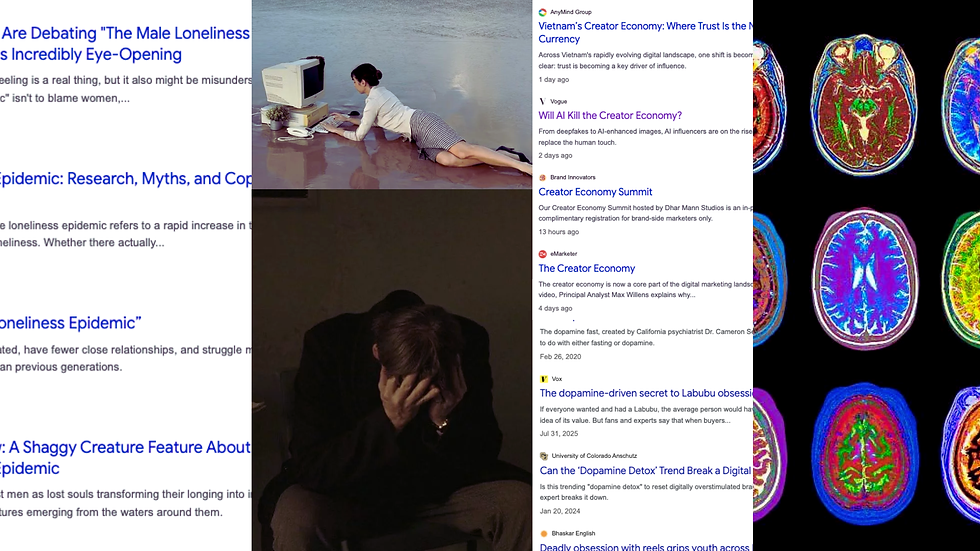
You’ve heard of them. I’ve heard of them. Whether in passing, through headlines, or in deeper dives, if they’ve caught your attention. They’re not new concepts, but they do feel particularly present — almost inescapable — in the way we live today.
And for some reason, in my head, all of these live in the same thought bubble. Call it a strange way of thinking, but do stay with me. Because everything is, in fact, connected.
The Claim: We Say We Crave Substance
As a society, we like to believe that we are craving substance. Depth. Meaning. Real connection. But if we’re being honest, we do very little to actually pursue it. Quite the contrary. We gravitate toward convenience. Toward stimulation. Toward whatever is easiest to consume. (If you’ve ever worked in marketing or market research, you’ll know: convenience often ranks above money, belonging, even permanence.)
We say we want depth, yet we choose immediacy.
The Attention Crisis
Earlier this year, I saved a podcast episode in my notes under that same question: Are we really craving substance?
It was Matt Damon and Ben Affleck discussing how attention spans are actively reshaping filmmaking. Studios and platforms, like Netflix, are now asking filmmakers to repeat plot points multiple times, to include constant stimulation, to assume that viewers are distracted, on their phones, half-watching.

Stories are being adapted to the distracted viewer. And while this may be a response to audience behaviour, I can’t help but think it also reinforces it. It doesn’t solve the problem. It deepens it.
For me, watching a film is almost sacred. I intentionally put my phone away. It’s one of the few moments where I allow myself to slow down and step out of the constant scroll. Because I am not outside of this. I am just as much a dopamine addict as anyone else.
Loneliness in the Age of Connection
Which brings me to another headline we keep seeing: the male loneliness epidemic.
Data shows that around 15% of men report having no close friends, a fivefold increase since 1990. A 2023 report found that two-thirds of men aged 18 to 23 feel that “no one really knows me” (AIBM, 2023).
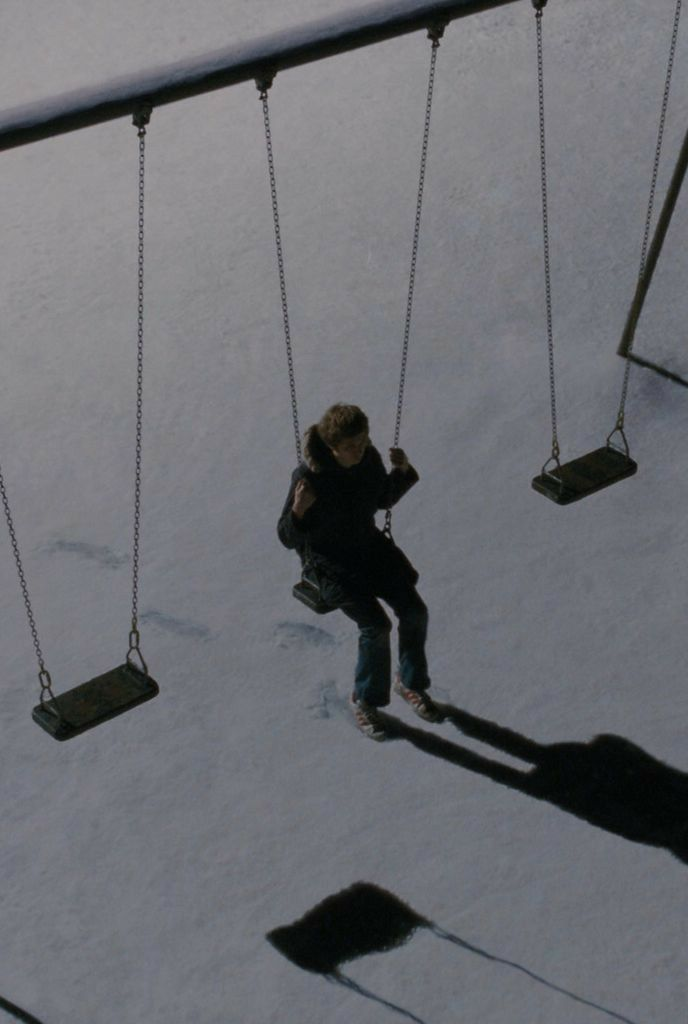
But this isn’t just about men. Loneliness is increasingly a shared experience across society. And if we look at heterosexual dynamics, it doesn’t simply stop on one side. If many men feel unseen or disconnected, that often leaves women navigating a similar emotional gap — especially in romantic contexts.
Perhaps the difference is that women have historically been conditioned, or at least expected, to nurture connection elsewhere, through friendships, family and community. But even then, romantically, it can begin to feel like the same story told from two perspectives: people wanting to be known, yet struggling to meet each other there.
And one of the underlying factors that is hard to ignore is, most certainly, technology.

We are living in a world where we are made to believe that everything we need is available at our fingertips. Connection included.
You don’t need to call someone — you can text. You don’t need to meet someone — you can swipe. You don’t need to open up — you can vent to your phone. From dating apps to adult content to AI companions, we have built entire systems that simulate connection.
And slowly, almost imperceptibly, they begin to replace it.
Friends become followers. Relationships become metrics. Connection becomes something to optimise.
The Substitution: From Connection to Simulation
What we are witnessing is not just a shift in behaviour. It is a shift in how we relate to one another. When real connection becomes difficult, slow, or vulnerable — we substitute it. With stimulation. With visibility. With performance.
Therefore, it comes as no surprise to see that critique with depth and in long form has declined in viewership or at least in people actually paying attention to it — and that goes beyond content and translates into our relationships.
Most people simply don’t want to put in the effort, and here I may be calling myself out, for I also am incredibly fearful of true intimacy — because of its requirement for genuine vulnerability.
The Creator Economy: Performing the Self
The distinction between consumer and producer has all but disappeared.
Today, everyone is — in some capacity — a creator. We document. We share. We perform. Even the most mundane aspects of our lives become content.

As Foucault might describe it, we are constantly engaged in a “technology of the self.” Except now, that self is not only shaped internally but also broadcast externally.
And in a world where visibility is currency, not being seen can feel like not existing at all. Which creates a tension. Because sometimes, I think we all feel the urge to disappear. To go ghost and to exist without performing. But the system rarely rewards that, or does it?
Dopamine and the New Environment
As Keith Humphreys, PhD, a professor of psychiatry and addiction researcher at Stanford Medicine, puts it,
“We’ve got an old brain in a new environment.”
Our brains were not designed for infinite scrolling, endless novelty, and constant stimulation. Yet that is exactly what we are immersed in. Over time, this creates what psychologists describe as maladaptive learning. The brain begins to prioritise stimulation over more fundamental needs, including connection.
And so we keep scrolling. Not because it fulfils us. But because it’s easier than stopping.

Fashion, Culture, and the Flattening of Identity
By now, it should be clear: Fashion does not exist in a vacuum.
In Mediatization and Digital Media in the Field of Fashion, Agnès Rocamora writes about how social media has “flattened fashion.” I would argue it has flattened much more than that. Our personalities, too, while we're at it.
In a world of constant exposure, everything becomes visible and therefore replicable. Aesthetic codes travel instantly. Trends circulate globally. Places begin to look the same. People begin to dress the same. Coachella becomes a uniform. Normcore becomes identity. Even “individuality” becomes a trend.
At the same time, there is a counter-reaction. A return to imperfection. To maximalism. To something that feels more human in contrast to AI-generated everything.

Fashion becomes both reflection and resistance. A way to express what we cannot quite articulate — or perhaps what we haven’t yet had the space to understand.
Final Reflection: Seen vs Known
While researching all of this, one thought kept coming back to me.
We say we crave substance. But we have built a world that rewards stimulation. Not depth. Certainly not vulnerability.
Maybe we’re not actually craving substance. Maybe we’re craving to be known, and end up settling for being seen instead.
And maybe the question is not whether we consume, or scroll, or perform too much. But whether, in all of that, we are slowly losing the ability — or the willingness — to truly connect with others, and even with ourselves.

By no means is this meant to be a call to disconnect entirely, but if it lingers in you enough to reflect upon it, I’ll consider it worthwhile. If anything, it’s merely an invitation to become more aware. To question what we engage with. And why.
Something that I’ve found particularly helpful is replacing digital with physical. I’ve never been a fan of digital books in the first place — they’re certainly more convenient than going out of your way to pick up a book — but the experience of reading a physical one is irreplaceable. The flickering of the pages, the sound each time one turns — it’s all a pleasure of its own.
I’ve started to “force” myself to carry one with me at all times, and now I think twice before reaching for my phone. If it’s not for answering a text, looking something up, or something genuinely needed, it simply doesn’t happen. And that has made my phone use far more intentional.
Another small tip: if you must scroll, do it mindfully. Pay attention to what you interact with, and make it a point to engage with things that actually interest you. Every time I come across a good piece of content — whether it’s a deep dive into a piece of furniture or design, a film, or a music genre analysis — I make sure to like or engage in some way, so the algorithm continues to show me more of that, instead of useless brainrot.
Because not everything we reach for is actually what we need. And not everything that makes us visible brings us closer to being known.


Comments