My First Printed Articles: A Milestone at BTSO TFF Magazine
- Genna Airam
- Apr 30, 2025
- 7 min read


There are moments in life that feel like a whisper from your younger self—a gentle reminder that all the dreams, sleepless nights, and moments of doubt were not in vain.
I’m incredibly proud to share that one of my articles has been published for the first time in a printed magazine: BTSO TFF Magazine, a publication dedicated to the latest trends and innovations in the textile and fashion industry.
The magazine will be distributed at major international events like the Bursa Textile Show and Première Vision Paris—a surreal milestone for someone who only formally began working toward a career in fashion less than six months ago, but has been writing, dreaming, and breathing fashion for as long as she can remember.
This Monday, I had the honor of attending the magazine’s launch at the Bursa Textile Show, one of Turkey’s most important textile industry fairs organized by the Bursa Chamber of Commerce and Industry (BTSO). It was incredibly moving to see my work showcased in a space filled with creativity, vision, and community.
For this edition, I’m honored to have contributed a feature piece titled:
“Threads of Culture: An Interview with Designer Vino Supraja”
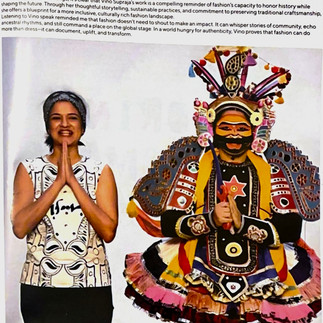
While I wait for the digital version of BTSO TFF Magazine to go live, I didn’t want to let this moment pass quietly. Below, you’ll find my article transcribed for easy reading, along with a few snapshots from the physical print.
This accomplishment feels small in the grand scheme of things—but to me, it’s everything. It’s the first tangible proof that I’m walking the right path, even from far away from home, fueled by the same passion that started when I was a little girl choosing her own outfits as a form of self-expression.
Thank you to IFA Paris Istanbul and BTSO TFF Magazine for this opportunity, and Vino Supraja for her time, trust, and inspiring words.
Here’s to more milestones—and to remembering that every step, no matter how small, is worth celebrating.
🕊 I’ll update this post with a high-res digital version as soon as it becomes available.
📸 Find more behind-the-scenes photos from the event and this experience over on the Fashion Gins Instagram. If you’re not following me there yet, come join the community so you don’t miss a thing! @fashiongins
If you're curious about the event or want to explore past editions of the magazine, you can find more information here: https://tffshow.com/
Threads of Culture: An Interview with Designer Vino Supraja
Fashion is more than what we wear—it's a living, breathing reflection of who we are. As cultures evolve, so does fashion, offering a canvas for stories rooted in tradition, memory, and identity. Today, some designers are choosing to use their platforms to preserve heritage while pushing creative boundaries.
As someone currently studying fashion media, I’ve become increasingly drawn to the intersection of storytelling and design. Like Vino, I see myself as a storyteller. Sometimes the narrative unfolds through fashion, other times through literature or photography—but at the heart of it is the same desire: to tell stories that move people. This isn't something I do because I have to, or because it's expected of me—or even because I consciously want to. Sometimes, it's simply a need.
Storytelling is a form of self-expression that feels essential to who I am. For me, fashion is powerful precisely because it can carry deeply personal or culturally resonant messages without a single word. Coming from Mexico, a country steeped in rich traditions, I often see echoes of my background in my own creative work—even when the stories I tell aren’t explicitly Mexican.
Knowing Vino personally, and admiring her commitment to sustainability and cultural preservation through her brand, Vino Supraja, I knew she was the perfect person to explore the idea of fashion as a cultural reflection. Her designs are rooted in heritage, yet speak effortlessly to global audiences. What followed was a conversation that revealed how she weaves her personal and cultural identity into garments that tell unforgettable stories—both intimate and far-reaching.
How has your own cultural identity influenced your perspective as a designer?
"Every collection that I have done so far has always been inspired from my childhood, from my roots, from the culture that I have grown into," Vino shares. She emphasizes that as an artist, one is deeply impacted by personal experiences, and that her creations are a natural extension of those roots. She points out that even when a collection isn't directly tied to her geographic origin, there remains a deep personal connection—often expressed through architectural references, reflecting her background as an architect.
Her debut collection, inspired by the novel Kite Runner, exemplifies how literary and cultural narratives have long shaped her creative process. Vino sees no separation between her personal identity and her brand, affirming, "My brand is just my reflection, right?" Each of her collections serves as a chapter of her life, a cultural narrative rendered in fabric and form.
Fashion is a powerful storytelling medium. Could you share how your designs narrate the cultural history and stories of the communities you work with?
Initially drawn to fashion with dreams of dressing celebrities and showcasing on runways, Vino’s path evolved as she began working closely with artisan communities. "As I started making collection after collection organically, the inspiration started coming from the roots. So I had to go back to the roots and work with and talk to these people," she reflects.
Recent examples include a collection inspired by a traditional folk performing art and another centered around a unique weaving technique from the Bhavani region. For Vino, storytelling takes precedence over trends: "I'll always be seeking for stories to tell, rather than seeking inspiration for collections to showcase. When I seek an interesting, meaningful story that I want to say, it will automatically become a collection."
Could you share a particular piece or collection that strongly resonated with audiences culturally? What do you think made it impactful?
Two standout collections illustrate her impact. Buoyancy, presented at Brooklyn Fashion Week, was inspired by the 2015 Chennai floods and celebrated the resilience of the city’s people. "The city bounced back within a week. People organized social volunteer groups on Facebook and WhatsApp... nobody gave anybody any task. It just organically [happened]," she says. The collection received a standing ovation, with the mayor of Brooklyn and the chief justice in attendance.
At London Fashion Week, Vino showcased a collection that included a live performance of a traditional art form—an unprecedented move in the fashion world that earned her an award at the British Parliament. "These two collections had major impact, [and were] very well received by the audience," she reflects.
Sustainability is integral to your brand. Can you explain the cultural significance of sustainability in traditional Indian textile practices, and how you've incorporated that ethos into your brand?
"The minute you embrace heritage and traditional techniques, right? That has been always sustainable. It is only the modernity and mass production which has made things worse in terms of sustainability," Vino explains. Her brand reflects this belief through practices such as working directly with artisans, using organic fibers, traditional weaving methods, and azo-free dyes, while minimizing plastic in packaging.
"Sustainability is a very vague umbrella. Anybody can claim to be sustainable. The meter of sustainability should be in the brand's heart, that there need not be an external body coming and judging you," she says. She also acknowledges limitations, emphasizing the importance of staying informed and adjusting practices as new insights emerge. "We try to be as sustainable and as ethical as possible... We learn, we unlearn."
Have you encountered any challenges when blending traditional Indian elements with contemporary aesthetics? How do you navigate potential cultural sensitivities?
"My whole mission is to bring the craftsmanship of these people to the global platform," Vino asserts. While local appreciation exists, she believes true support requires global visibility—and adaptation. "You can't make something very, very Indian and traditional out of what they make, and then try to sell in the global market, because it will never be as appreciated as it is locally."
Her solution is to reimagine: transforming traditional items like rugs into functional fashion pieces, such as premium bags. "But there were challenges... rugs are rectangular. In bags, you need to bend them, add darts, top stitching..." The same applies to silhouettes: "It can be the point of inspiration, but it has to be relevant with what is happening in the world currently."
"You have a rich inspiration in hand, but if you're going to present it as it is, it will look overly traditional or culturally specific in a way that might not fully translate across audiences, and you cannot expect everyone in the world to be attracted to it. You want to appeal to the global mass, not just the niche that loves Indian stuff."
Your brand celebrates artisanship. Can you discuss the importance of preserving traditional craftsmanship in today’s fast-fashion dominated world?
Vino offers a passionate account of her visit to Bhavani, a town once known for its rug-making. "My heart was weeping to see hundreds of looms broken with cobwebs... there was one operational loom where an 80-plus-year-old man was sitting and weaving."
She stresses that crafts are disappearing as younger generations seek government jobs instead of continuing artisanal traditions. "These hidden gems... are just fading off. These artisans don't know how to reach markets, can't respond to emails, don't understand global standards."
Her call to action includes government training programs, stipends, and support to connect artisans with international audiences. She leaves us with a beautiful metaphor: "If I cannot be the sun, which will give light to the whole world, I will at least be a street light... If I cannot even be the street light, I'll be a lamp inside a house."
What advice would you give emerging designers who wish to honor their cultural roots while appealing to international markets?
"It should come to terms even before entering this bandwagon, that it is not going to be an easy win," Vino cautions. She urges young designers to let go of glamorized expectations and focus on the journey: "Just look at that particular step, step after step and go. Just keep going."
Her advice is rooted in authenticity and persistence—interpreting culture in ways that feel personal yet universal. "You have to balance tradition with global relevance," she adds. Success lies in transforming rooted inspiration into expressions that speak across borders, not just to niche audiences.
In reflecting on our exchange, it's clear that Vino Supraja’s work is a compelling reminder of fashion’s capacity to honor history while shaping the future. Through her thoughtful storytelling, sustainable practices, and commitment to preserving traditional craftsmanship, she offers a blueprint for a more inclusive, culturally rich fashion landscape.
Listening to Vino speak reminded me that fashion doesn’t need to shout to make an impact. It can whisper stories of community, echo ancestral rhythms, and still command a place on the global stage. In a world hungry for authenticity, Vino proves that fashion can do more than dress—it can document, uplift, and transform.




Comments